
Resistance to Change in Healthcare
'Progress is impossible without change, and those who cannot change their minds cannot change anything.' – George Bernard Shaw
Changing one's habits is a gradual process that requires patience and consistency, often involving setting realistic goals, tracking progress, and staying motivated.
The Analogy of the Suitcase
One monumental change in history was a product we all know well – the wheeled suitcase. The simple and obvious idea of adding wheels to a suitcase was rejected time and again. All the major department stores knocked back the idea as ludicrous. Bernard Sadow patented the first wheeled suitcase in 1970, but scepticism and resistance continued throughout the 1970s. It wasn't until the 1980s, with the rise of air travel, that wheeled suitcases began to gain popularity. By the 1990s they were mainstream. The transition from scepticism to widespread acceptance spanned roughly 20 to 30 years – and today, you would never see a suitcase without wheels in any airport in the world.
Theatre Badge Hats – A Recombinant Innovation
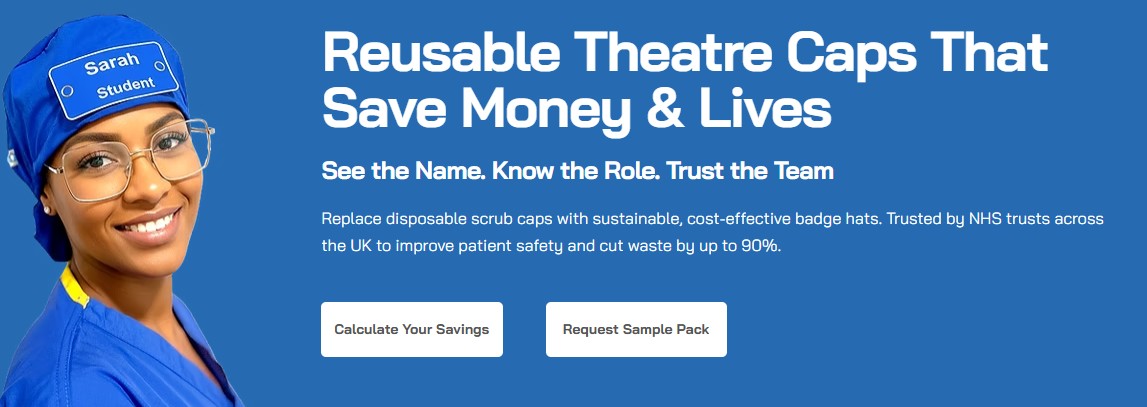
Adding wheels to a suitcase is an example of recombinant innovation – combining two existing concepts to create something more functional. Theatre badge hats are another example: combining a name badge with a theatre hat to create an identifiable, detachable garment. Just like the simplicity of a basic name badge that has been used for decades.
Transitioning from disposable to reusable theatre hats is a great initiative for sustainability and patient safety. However, familiarity with a product that is thrown away after each use, versus one that is reused, raises questions around ordering, storage and laundering. Education of end users is paramount – informing staff about the environmental, patient safety and communication benefits is key to acceptance.
Quality Considerations
Durability, comfort and easy-to-maintain fabric are essential. While materials like 100% cotton and hemp are initially better for the environment, washing at high temperatures without causing shrinkage must be considered. Polycotton has been the preferred fabric for scrubs for decades – it can be laundered at high temperatures without concerning shrinkage, and is cost-effective.
The 'Hello, My Name Is' Campaign
In 2013, the 'Hello my name is' campaign highlighted the tremendous benefits for patients and staff of knowing the names of healthcare professionals. Fast forward ten years and most hospitals have adopted this proven best practice, with staff wearing yellow name badges throughout wards and departments in both NHS and private sectors. Black text on a yellow background was found to provide the best contrast for those with visual impairments, dementia or dyslexia.
The Theatre Cap Challenge
In 2018, the Theatre Cap Challenge saw mixed responses. Some staff thought the idea of wearing names on hats was fantastic – improving teamwork and communication. Others refuted the change, preferring to remain 'unknown' during surgery, or objecting to feeling self-conscious. Sometimes the variance of opinion is so vast that the outcome is simply to remain with current practice. Disposable theatre caps have been used for over 30 years and, despite many objections over the years, acceptance has been widespread simply because there has been no other choice.
Accepting Change
Accepting change often takes time. People can be resistant due to comfort with routine, fear of the unknown, cognitive dissonance, social influence, or past negative experiences. Change can bring uncertainty and anxiety. Without a clear incentive or personal reason to change, individuals may not value or embrace it – which is why education about the full range of benefits of our theatre badge hats is so crucial.